In Colombia, sugarcane cultivation has long played a central role in the country’s agricultural and economic landscape. Alongside aguardiente, an aniseed-based spirit made from sugarcane alcohol that has established itself as the country’s emblematic drink, the production of Colombian rum has gradually developed in direct connection with the sugar industry.
Although the production of rum in Colombia is documented in a more uneven way than in other countries, it dates back to the colonial period and reflects a lasting presence in several regions across the country.
Historical foundations: an ancient sugar-making tradition
As across much of the continent, the introduction of sugarcane stems from its establishment in the Caribbean from the late 15th century onward.
Distillation techniques developed in the Caribbean then spread to mainland territories throughout the 17th and 18th centuries, in step with the expansion of plantations.
In Colombia, this dynamic took shape within an agricultural economy in which sugarcane held a significant position, particularly along the Caribbean coast, in areas best suited to its cultivation. The growth of the sugar industry created the necessary conditions for the production of sugarcane-based spirits, including Colombian rum.
Colombian rum versus aguardiente in the 19th century
Often regarded as the national drink, anise-flavoured aguardiente has historically occupied a central place in Colombian culture. Alongside its production, rum production also developed, supported by the same agricultural and industrial infrastructures, with molasses as its primary raw material.
The coexistence of these two spirits has led to a distinct distribution of their uses and representations:
- Aguardiente consumption, deeply rooted in popular culture, has played a major cultural and festive role throughout the country since the 19th century;
- In Colombia, rum long remained part of a complementary regional production, developed during the 19th century alongside aguardiente. It was not yet a central or highly valued product, but rather accompanied the growth of the local sugar industry, following an artisanal and later semi-industrial model, comparable to what can be observed in other regions of South America.
From artisanal development to structured production in the 19th century
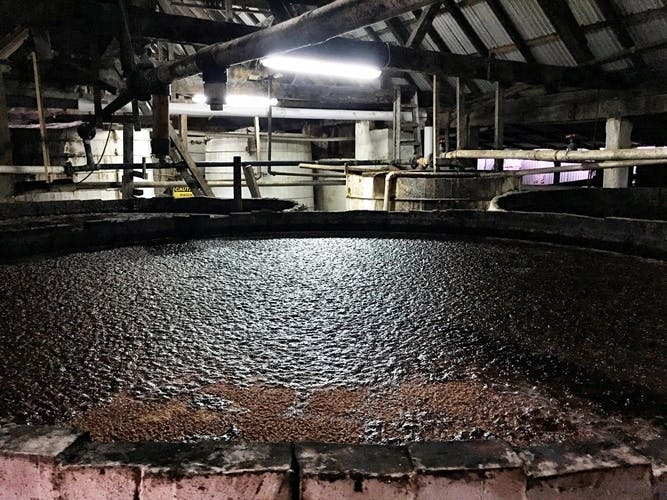
Like its neighbouring countries, Colombia developed its sugar industry during the 19th century. Molasses became an essential by-product, and the local production of Colombian rum began to stabilise in certain regions following the country’s independence (1810–1820). Production methods remained largely artisanal, although some distilleries started to refine their rum.
Distilleries gradually adopted column distillation, a hallmark of Hispanic styles, favouring:
- light aromatic profiles;
- a focus on consistency;
- production suited to local consumption as well as export.
This structuring process nevertheless varied from one region to another, which partly explains the present-day diversity of Colombian rums.
A heterogeneously documented production
Available sources indicate that Colombia produces rum on a regular basis, although documentation remains less consistent than for countries such as Venezuela or Guyana.
What can nevertheless be established with certainty is that production relies primarily on molasses, that column distillation gradually became widespread over the course of the 20th century, and that several regions of the country produce aged rums, in line with Hispanic traditions.
From the early 20th century onwards, the industrialisation of the sector led to the creation of modern distilleries, contributing to a more standardised production. Some houses founded during this period helped structure the national market, gradually orienting Colombian rum towards ageing and quality, in order to compete with imported rums.
Colombian rum today
Colombian rum today fits within a coherent group of South American styles shaped by Hispanic heritage, based on continuous distillation, smooth profiles, and ageing under a tropical climate.

While volumes remain more modest than in countries such as Cuba, the Dominican Republic or Puerto Rico, Colombia stands out for the gradual premiumisation of certain producers, which have oriented their production towards aged and premium rums. Brands such as Dictador, widely distributed internationally, illustrate this evolution and contribute to the global visibility of Colombian rum in high-end, and even luxury, segments.
TO DISCOVER RUM FURTHER
La Maison du Whisky has three boutiques in Paris:
In each of these boutiques, you'll find a wide selection of whiskies, rums, sakes, and other fine spirits.
Follow our tasting calendar for upcoming events, or visit the Golden Promise Whisky Bar, which offers an extensive selection of whiskies and other spirits by the glass.
You can also discover other articles about rum.


